 Although it has been a fairly good start to the year for the employment market, not everyone is cooking with gas just yet, as the Hudson Report: Employment Trends for Q1 2013 shows.
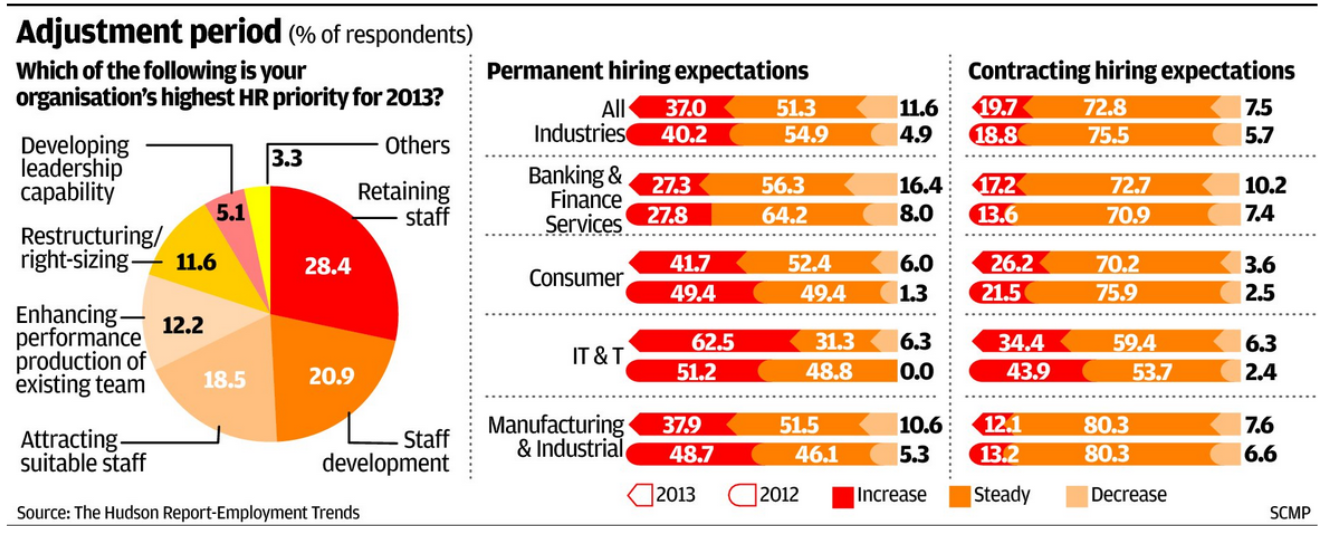
The report, which surveyed 5,900 employers from four major industries, found that IT&T (information technology and telecommunications) was the only industry with increased positive hiring intentions. On the other side of the coin, hiring intentions dropped seven percentage points in the consumer-business sector, ten points in manufacturing and industrial, and 0.5 points in banking and financial services (banking and financial-services employers also showed the strongest intentions to decrease headcount).
Tony Pownall, general manager of Hudson Hong Kong, says that the drop in the consumer-business sector reflects the fact that mainland visitors are not buying as much as they used to. Hiring in IT&T, meanwhile, is being driven by demand from businesses to improve both efficiency and profitability via technology.
“Permanent-hiring restrictions among some multinational corporations are resulting in increased demand for vendor services and there is a continuing trend towards the outsourcing of core IT functions,” he says. “Big data and the technology associated with manipulating it to support decision-making and improved customer relationships are also continuing to grow in popularity.”
The outsourcing trend is not just within IT&T. The report also shows that contracting roles are slowly growing in acceptance in Hong Kong, with a third of businesses using contractors more regularly.
Pownall says that part of the reason for this is that workloads are up 41.8 per cent compared to a year ago. This is being driven largely by more projects (according to 75.3 per cent of respondents), which naturally lend themselves to contracting support.
He adds, though, that stable jobs have always been favoured in Hong Kong. “High living costs and cultural-status issues drive a preference for permanent roles, and contracting is still not seen as a lifestyle choice as it is in other markets,” he says. “Sometimes companies switch contract roles to permanent roles in order to improve their chances of finding a good candidate.”
Good candidates with the right skills, however, are rather thin on the ground. Marc Burrage, regional director of Hays in Hong Kong, says that this shortage is triggering companies to use more flexible staffing tactics, such as looking overseas or outsourcing.
“We still have a skills shortage and are seeing more employers willing to hire or sponsor qualified overseas candidates in skill-short areas,” he says. “Many more are now using flexible staffing approaches than in the past 12 months as part of a flexible approach.”
The use of these workers is likely to increase even more over the next year as Hong Kong looks set to continue as a candidate-short market, he adds.
This shortage goes a long way in explaining another of the Hudson report’s findings – that staff retention is the top HR priority for Hong Kong employers, with 28.4 per cent placing it above all other concerns.
“Employers are very aware of the challenges of securing the right talent, which are exacerbated by skills shortages and challenges in securing headcount approvals,” Pownall says.
He adds that employers are conscious of the fact that strong employee engagement is the key to staff retention, and a high staff turnover causes disruption and affects productivity.
“The right people in the right roles are critical to retaining staff, so giving due consideration to behavioural and motivational fit is important, as these are far more effective indicators of high performance than technical skills,” he says.
Pallavi Anand, director of Robert Half Hong Kong, says that she has also observed a fresh emphasis on staff retention recently as a result of companies being at greater risk of losing their best talent to competitors.
“Whether companies are looking to retain or hire new employees, they need to ensure that they are offering more than just an attractive salary,” she says. “Candidates want to clearly understand how a company can help them build their skill sets and develop their career. In such a competitive market, factors such as a clear career path, a commitment to work-life balance, and greater responsibilities and challenges will strongly influence individual career decisions and help firms attract and retain talent.”
Originally published in South China Morning Post, March 23, 2013




 billy-clarke.com